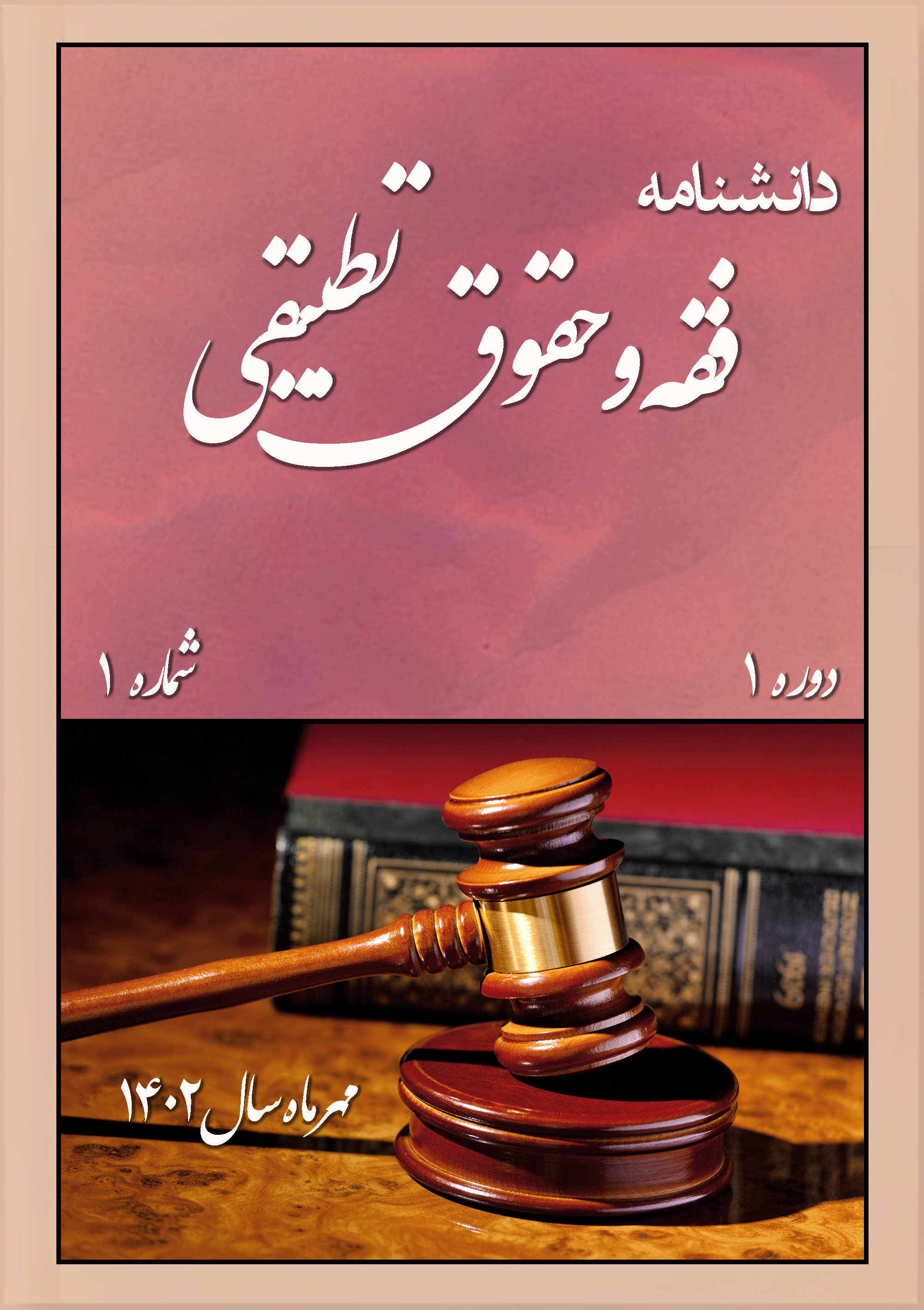
An Analysis of the Jurisprudential and Legal Foundations of Divorce at the Wife’s Request in Imami Jurisprudence and Iranian Civil Law
Keywords:
Divorce at the Wife's Request, Imamiyyah Jurisprudence, Family Law, Hardship (Osr va Haraj), Iranian Civil Code, Family Protection Law, Principle of No Harm (La Darar)Abstract
Divorce at the wife’s request is one of the most important and challenging issues in family law within the Iranian legal system, situated at the intersection of Imami jurisprudence and positive law. Although, in principle, the authority to initiate divorce in Imami jurisprudence and Iranian Civil Law rests with the husband, jurisprudential rules such as the rule of no harm, the negation of hardship and distress, fulfillment of contractual stipulations, the obligation of maintenance, and the authority of the religious judge have provided grounds for supporting the wife under specific circumstances. The present study was conducted with the aim of analyzing the jurisprudential and legal foundations of divorce at the wife’s request in Imami jurisprudence and Iranian Civil Law, and evaluating the effectiveness of existing regulations in protecting women’s rights. In terms of purpose, this research is applied, and in terms of method, it is descriptive-analytical. Its data were collected and analyzed using authoritative jurisprudential and legal sources, statutes, judicial practices, and library documents. The findings indicate that Imami jurisprudence possesses considerable capacities for supporting women in situations such as hardship and distress, failure to provide maintenance, the husband’s absence, fulfillment of stipulations incorporated into the marriage contract, and other exceptional cases. The Iranian legislator, inspired by these foundations, has also provided for the possibility of divorce petitions by the wife in specified cases. Nevertheless, differences in the interpretation of legal provisions, the absence of unified judicial practice in identifying instances of hardship and distress, the difficulty of proving claims, and the prolonged nature of adjudication proceedings are among the most significant practical challenges in implementing these regulations. Consequently, enhancing the effectiveness of the legal system in this area requires the establishment of unified judicial practice, a dynamic and justice-oriented interpretation of jurisprudential rules, revision of certain legal provisions, and greater utilization of the capacities of Imami jurisprudence in protecting women’s legitimate rights, while preserving the stability of the family.
Downloads
References
An-Na'im, A. A. (2002). Islamic Family Law in a Changing World. Zed Books.
Esposito, J. L., & DeLong-Bas, N. J. (2001). Women in Muslim Family Law (2nd ed.). Syracuse University Press.
Hurr al-Amili, M. (1988). Wasa'il al-Shi'a. Al al-Bayt Institute.
Imam, K. (2000). Tahrir al-Wasilah (Vol. 2). Institute for Compilation and Publication of Imam Khomeini's Works.
Ja'fari Langroudi, M. J. (2012). Legal Terminology. Ganj-e Danesh Publications.
Katouzian, N. (2013). Family Law (Vol. 1). Mizan Publishing.
Makarem Shirazi, N. (2007). Al-Qawa'id al-Fiqhiyyah (Vol. 1-3). Imam Ali ibn Abi Talib School Publications.
Mohaqqeq, H. (1988). Shara'i al-Islam fi Masa'il al-Halal wa al-Haram. Isma'iliyan Publications.
Najafi, M. H. (1984). Jawahir al-Kalam fi Sharh Shara'i al-Islam (Vol. 29-33). Dar Ihya al-Turath al-Arabi.
Safaei, H., & Emami, A. (2018). Family Law (5th ed.). SAMT Publications.
Shahid, T. (1990). Masalik al-Afham. Islamic Publications Office.
Tabatabaei Yazdi, S. M. K. (1998). Al-'Urwah al-Wuthqa. Islamic Publications Office.
Welchman, L. (2007). Women and Muslim Family Laws in Arab States: A Comparative Overview of Textual Development and Advocacy. Amsterdam University Press.
Downloads
Publication Timeline
- Submitted
- Revised
- Accepted
Issue
Section
License
Copyright (c) 2025 Atefeh Sharafatmanesh (Author); Abbas Arab Khazaeli; Sayyed Askari Hosseini Moghadam (Author)

This work is licensed under a Creative Commons Attribution-NonCommercial 4.0 International License.